
Why a Marine Fuel Bladder Tank Is the Smarter Choice for Offshore Range
A marine fuel bladder tank is a flexible, collapsible fuel storage container designed to carry additional gasoline or diesel aboard a vessel without the cost, complexity, or permanence of a rigid installed tank.
Quick answer for buyers:
| Need | Marine Fuel Bladder Delivers |
|---|---|
| More offshore range | Add 30–300+ gallons of auxiliary fuel capacity |
| No permanent tank modification | Deploy on deck, fully collapsible when empty |
| Gasoline or diesel compatibility | TPU-coated polyester handles both fuel types |
| Custom sizing | Available from 30 gallons up to 250+ gallons (custom orders available) |
| Space efficiency | Folds flat for compact storage between trips |
For operators running long offshore legs — canyon fishing runs, extended passages, or commercial work vessel deployments — carrying enough fuel isn’t optional. It’s the difference between a successful trip and an expensive problem.
The challenge is that most production vessels aren’t built with enough tank capacity for serious offshore work. Permanently upgrading a rigid tank means shipyard time, significant cost, and a fixed commitment. A marine fuel bladder solves this differently: deployable when you need it, stowed flat when you don’t, and sized to match your actual fuel burn — not a worst-case estimate.
Sizes commonly used for offshore auxiliary fuel range from 50 gallons up to 250+ gallons, with custom configurations available for specialized vessels, work boats, and expedition craft. Pricing depends on capacity, configuration, and any custom requirements — request a quote for accurate figures based on your specific use case.
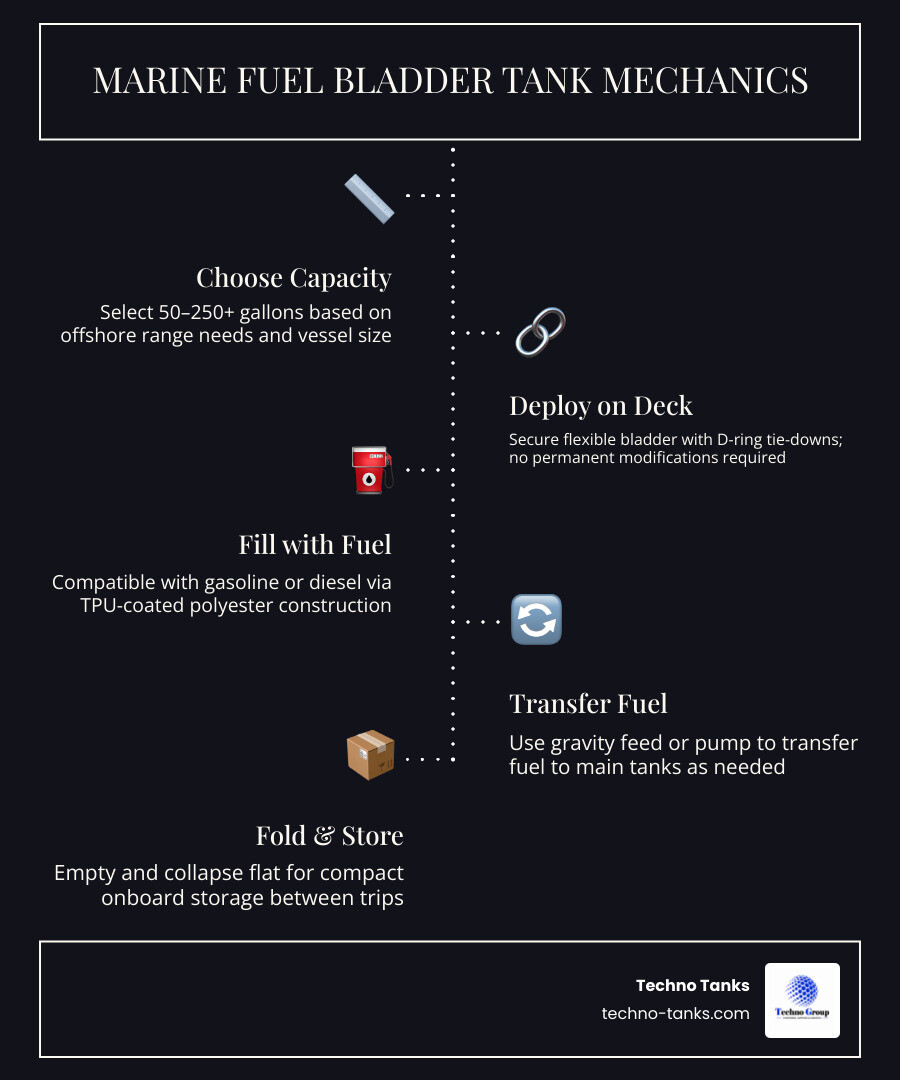
Key marine fuel bladder tank vocabulary:
Understanding the Marine Fuel Bladder Tank vs. Permanent Rigid Tanks
When planning for extended voyages, vessel operators often face a fundamental choice: install a larger permanent vessel tank, add permanent saddle fuel tanks, or utilize a temporary, collapsible system. Understanding how these options differ in weight distribution, cost, and utility is critical for making an informed commercial decision.
Permanent Vessel Tanks vs. Collapsible Fuel Tanks
Permanent rigid tanks — whether constructed from aluminum, stainless steel, or polyethylene — are excellent for base-level operations. However, upgrading them or adding secondary rigid tanks introduces several structural and financial pain points.
Rigid tanks require dedicated, permanent space within the hull or on deck. If placed below deck, installation often requires cutting fiberglass, relocating existing machinery, and rebalancing the vessel’s center of gravity. Furthermore, once installed, a rigid tank takes up the same physical volume whether it is completely full of fuel or entirely empty.
A collapsible marine fuel bladder tank, by contrast, offers unmatched space-saving storage. When empty, it can be rolled up, folded flat, and stowed away in a small locker, returning valuable deck space to the crew for fishing, cargo transport, or daily operations. This makes them the ultimate choice for temporary fuel storage during seasonal relocations, long-range tournaments, or single-leg deliveries.
For a comprehensive breakdown of these operational differences, consult the Fuel Bladder vs Fuel Tank guide and explore the Everything You Need to Know About Portable Marine Tanks resource.
Comparison Matrix: Flexible Bladders vs. Rigid Tanks
| Feature | Flexible Marine Fuel Bladder | Permanent Rigid Fuel Tank |
|---|---|---|
| Space Utilization | Collapses flat when empty; temporary deck footprint. | Fixed footprint; occupies space permanently. |
| Installation Complexity | Low; placed on deck and secured with tie-down straps. | High; requires professional plumbing, hull modification. |
| Weight Management | Weight decreases as fuel is burned, allowing space recovery. | Static weight of the tank structure remains permanently. |
| Venting Requirements | Self-venting; collapses as fuel is drawn (no air pocket). | Requires external vent lines to prevent vacuum lock. |
| Cost & Construction Time | Cost-effective; rapid deployment. | Expensive; long shipyard lead times. |
| Customization | Highly adaptable to deck spaces and custom layouts. | Limited by hull geometry and internal bulkheads. |
Sizing, Types, and Custom Engineering Options
Selecting the right style of collapsible fuel tanks is just as important as choosing the correct capacity. Depending on your vessel’s deck layout, transom design, and cockpit space, certain configurations will perform better than others.
Pillow Style vs. Space Saver Bladders
Marine fuel bladders generally fall into two primary design categories:
- Pillow Style Bladders: These feature a wide, low-profile footprint. Because the fuel weight is distributed over a larger surface area, pillow-style bladders are exceptionally stable in rough seas. They are ideal for placement on wide cockpit decks, open bow areas, or center-forward deck sections where vertical height must be kept to a minimum.
- Space Saver Bladders: These are engineered with a more compact, vertical footprint, often utilizing internal baffling to control fuel sloshing. Space saver models are designed to sit snugly against the transom or along the side gunwales, leaving the center of the cockpit open for fishing or work activities.
To determine which footprint matches your boat’s deck geometry, refer to the Fuel Bladder Sizing Guide and read about Popular Marine Fuel Bladder Sizes and Their Uses to see how other operators configure their decks.
Selecting the Right Marine Fuel Bladder Tank Capacity
Vessel owners must balance their range extension goals with the weight-carrying capacity of their craft. Fuel is heavy — gasoline weighs approximately 6.1 lbs per gallon, while diesel weighs roughly 7.1 lbs per gallon. Placing a 300-gallon bladder (weighing over 2,100 lbs) on the deck of a light sport-fishing boat can severely degrade performance and stability if the hull isn’t designed for it.
Common off-the-shelf capacities include:
- Low-Capacity Options (30 to 60 Gallons): Perfect for smaller center consoles or day boats needing just enough reserve to fish the outer ridges. A 50 Gallons Marine Fuel Bladder is highly portable and easily managed by a small crew.
- Mid-Capacity Options (100 to 150 Gallons): The sweet spot for mid-sized sport-fishing vessels and cruising yachts. A 100 Gallons Marine Bladder provides substantial range extension without completely dominating the cockpit.
- High-Capacity Options (200 to 300+ Gallons): Built for large offshore sport-fishers, motor yachts, and commercial workboats. A 250 Gallons Marine Bladder or larger is typically positioned on the centerline of the cockpit deck to maintain optimal vessel trim.
Custom Marine Fuel Bladder Tank Engineering
No two boat decks are identical. When standard dimensions do not align with your hatch layouts, engine boxes, or tie-down points, custom engineering is the solution.
Through Custom Fuel Bladders design services, operators can specify exact length, width, and height requirements. Customization also extends to fabric thickness, baffle configurations, and the placement of specialized fittings (such as dual-action aluminum flanges with Viton seals). Reviewing the technical Fuel Bladder Specs ensures that your custom bladder will withstand the high-vibration, high-shear environment of offshore transit.
Material Standards, Safety, and Operational Best Practices
When carrying highly flammable or combustible liquids on an open deck, material integrity is paramount. Cheap, single-layer plastics or unreinforced polymers are highly susceptible to puncture, UV degradation, and chemical breakdown when exposed to marine fuels.
TPU-Coated Polyester and Military-Grade Durability
High-quality marine fuel bladders are manufactured from heavy-duty, military-grade TPU (Thermoplastic Polyurethane) coated polyester fabrics. TPU is chosen for its extreme resistance to:
- Hydrocarbons: It will not degrade, delaminate, or leach plasticizers when exposed continuously to gasoline, diesel, bio-diesel, ethanol, or methanol.
- Environmental Exposure: Built-in UV stabilizers and hydrolysis additives protect the bladder from intense sunlight, salt air, and extreme temperatures ranging from -40°C to 90°C.
- Mechanical Stress: High-tensile strength standards and RF-welded (Radio Frequency) or hot-air-welded seams prevent leaks at critical stress points, even when the vessel is pounding through heavy head seas.
For specific material compatibility and fuel-handling safety, consult the dedicated resources for Diesel Fuel Bladders and Gasoline Fuel Bladders.
Installation, Securing, and Fuel Transfer Protocols
Safely deploying a marine fuel bladder tank requires strict adherence to operational best practices:
- Deck Preparation: Before placing the bladder, thoroughly clean the deck. Remove any sand, fishing hooks, sinkers, or sharp debris that could cause abrasion. Using an integrated deck protection mat is highly recommended to act as a barrier between the deck non-skid pattern and the bladder fabric.
- Securing the Bladder: Never fill a bladder without securing it first. Full bladders can weigh anywhere from 150 to over 3,000 lbs. If left unsecured, they become highly dangerous projectiles in rough water. Utilize heavy-duty, ratcheting tie-down straps attached to the bladder’s integrated D-rings and secure them to high-strength deck cleats or pad-eyes. Adjust the straps as fuel is consumed and the bladder collapses.
- Filling Strategy: Always fill the bladder in situ (on the deck where it will be used). Do not attempt to fill a bladder on a dock and carry it onto the vessel; a full bladder is virtually impossible to grasp safely and can easily rupture if dropped.
- Plumbing and Transfer: You can transfer fuel using two primary methods:
- Direct Plumbing: Plumbing the bladder directly into the vessel’s primary fuel system via quick-connect fittings and selector valves. As the engine draws fuel, the bladder collapses naturally, eliminating the need for an air vent and minimizing vapor accumulation.
- Transfer Pumps: Utilizing external fuel transfer bladders systems or dedicated 12V/24V transfer pumps to move fuel from the bladder into the boat’s main rigid tanks once those tanks have burned down enough volume to accept the transfer.
For step-by-step instructions on safe transfer methods, refer to How to Transfer Fuel from a Fuel Bladder.
Frequently Asked Questions About Marine Fuel Bladders
Can I mount a fuel bladder below deck?
No. United States Coast Guard regulations and marine safety standards strictly prohibit mounting temporary or flexible fuel bladders below deck or in-hull.
Placing a bladder below deck introduces severe risks of vapor accumulation in enclosed bilge spaces, where a single electrical spark could cause a catastrophic explosion. Keeping the bladder on deck ensures that any minor spills during filling are easily washed overboard, venting occurs safely in the open air, and the crew can visually monitor the integrity of the fittings at all times.
For a detailed review of safe placement and storage regulations, see The Complete Guide to Marine Bladder Tanks and Storage.
How do I safely store a collapsible fuel bladder when empty?
Proper storage is the key to maximizing the lifespan of your flexible tank. When the bladder is empty:
- Purge any remaining fuel by rolling the bladder from the outer edges toward the discharge flange.
- Rinse the exterior with fresh water to remove salt residue, and ensure the entire unit is completely dry to prevent mold or hydrolysis damage.
- Fold or roll the bladder flat according to the manufacturer’s guidelines.
- Store the collapsed bladder in a dry, dark, well-vented locker away from sharp tools, heavy equipment, or direct sunlight.
To learn more about maximizing your equipment’s durability, read How to Extend Fuel Bladder Lifespan with 5 Easy Changes.
Will a full fuel bladder float if it falls overboard?
Yes. Marine fuels (both gasoline and diesel) have a density of roughly 2/3 that of water. Because the fuel is lighter than water, a full marine fuel bladder will naturally float if it is swept overboard in heavy seas.
In fact, in emergency survival situations, an empty bladder can be lightly inflated with air and sealed to serve as an auxiliary flotation device. However, this natural buoyancy is no excuse for poor lashing. Always ensure your tie-down protocols are fully executed before leaving the dock.
For more safety insights, consult the Beginners Guide to Fuel Bladders for Boats.
Conclusion
Carrying auxiliary fuel on deck is a serious undertaking that requires high-grade equipment, precise planning, and a commitment to safety. For offshore operators, a high-quality marine fuel bladder tank is the ultimate tool for range extension, providing a heavy-duty, space-saving alternative to permanent hull modifications.
Techno Tanks manufactures premium, military-grade flexible fuel bladders designed to survive the harshest marine environments. Whether you need a standard 50-gallon deck bladder for weekend tournament runs or a custom-engineered 300-gallon baffled system for commercial offshore logistics, Techno Tanks delivers the reliability you need to explore further with confidence.
Explore the complete advantages of our bulk liquid solutions by reading Why You Should Use Techno Tanks and Marine Fuel Bladder for Marine Bulk Liquids, or browse our full range of products on the Marine Fuel Bladders page. Ready to configure your vessel’s auxiliary fuel system? Contact our engineering team today to request a custom quote tailored to your exact dimensions and range requirements.

