
Why the Right Boat Fuel Bladder Solution Changes Everything Offshore
Boat fuel bladder solutions are one of the most practical ways for vessel operators to extend range, carry backup capacity, or manage auxiliary fuel without installing permanent rigid tanks.
Here’s what you need to know at a glance:
- What they are: Collapsible, flexible tanks made from military-grade TPU or reinforced fabric that store gasoline or diesel safely on deck
- Who uses them: Yacht operators, offshore fishing crews, commercial marine operators, and expedition teams
- Key sizes available: 30 gallons up to 300 gallons standard, with custom sizes available beyond that range
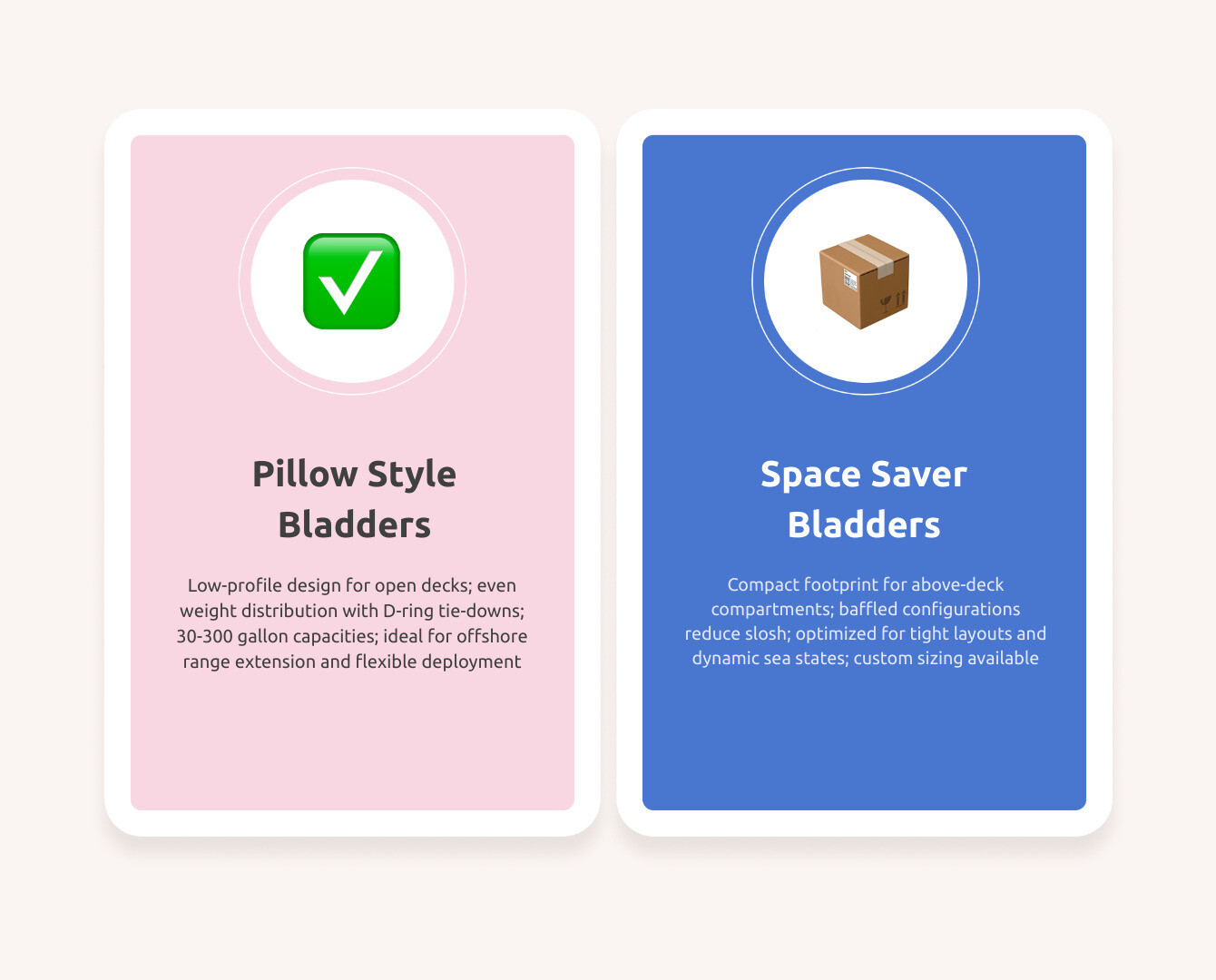
- Two main form factors: Pillow Style (low-profile, open deck) and Space Saver (compact footprint, tighter spaces)
- Fuel compatibility: Gasoline and diesel — but material selection matters; polyether TPU suits gasoline, polyester TPU suits diesel
- Where they mount: Above deck only — Coast Guard regulations prohibit in-hull placement
- Pricing: Varies by size, fuel type, configuration, and custom requirements — request a quote for accurate pricing
For operators planning longer transits, extended offshore stays, or routes with limited fuel access, the difference between a rigid tank and a flexible bladder comes down to space, weight, and deployment speed. A bladder folds flat when empty. A rigid tank does not.
Techno Tanks manufactures marine fuel bladders in small (30–80 gallons), medium (100–150 gallons), and large (200–300 gallons) configurations — all built to military-grade material standards and engineered for salt, UV, and vibration exposure in demanding marine environments.
This guide walks through sizing logic, material selection, form factor tradeoffs, custom engineering options, and safe deployment protocols — so you can match the right bladder to your vessel and mission.
Essential boat fuel bladder solutions terms:
Understanding Boat Fuel Bladder Solutions for Offshore Range Extension
When navigating remote waters, vessel operators frequently face a stark mathematical reality: the factory-installed fuel capacity limits the safe operating radius of the vessel. Installing a secondary, permanent rigid metal or plastic tank is often impractical due to structural layout constraints, high shipyard labor costs, and permanent weight distribution penalties.
Flexible fuel bladders solve this dilemma by providing temporary, highly resilient auxiliary storage. These systems allow operators to optimize their payload dynamically. When heading out on a long transit, the bladder is filled to maximize range. Once the fuel is transferred into the vessel’s primary fuel system, the empty bladder collapses flat, freeing up valuable deck space for fishing, diving, or general operations.
To explore the engineering principles behind these temporary systems, operators can consult The Ultimate Guide to Marine Auxiliary Storage Bladders.
How a Gasoline Boat Fuel Bladder Solutions System Operates
A marine fuel bladder functions as a closed, collapsible system. Unlike rigid tanks, which require mechanical venting to allow air to replace consumed fuel, a flexible bladder collapses inward as fuel is drawn out. This eliminates the headspace where explosive fuel vapors typically accumulate, significantly reducing the risk of fuel degradation and condensation.
In practice, fuel transfer is achieved using three primary methods:
- Gravity Feed: By securing the bladder on an elevated deck space or cabin top, operators can utilize gravity to feed fuel directly into the boat’s primary deck fill.
- Siphon Transfer: Utilizing manual or low-profile hand siphons to initiate fuel flow safely.
- External Fuel Pumps: Transferring fuel via specialized, explosion-proof external pumps rated for marine environments.
Because the system relies on physical placement for optimal transfer, choosing the correct location on deck is critical. For a deeper dive into the basic setup and operation of these systems, refer to the Technical Guide to Fuel Bladders for Boats.
Key Benefits of Flexible Bladders vs. Rigid Tanks
Evaluating the structural tradeoffs between rigid auxiliary tanks and flexible bladders highlights several distinct advantages for the flexible approach:
- Weight Distribution: A rigid auxiliary tank adds permanent dry weight to the vessel, even when empty, which negatively impacts fuel efficiency and planning performance. A flexible bladder can be rolled up and stored in a locker, eliminating unnecessary weight when auxiliary fuel is not required.
- Space Recovery: Once empty, a high-quality TPU bladder achieves up to 90% space recovery. For example, a 100-gallon bladder that occupies a significant portion of the deck when full can be folded down into a compact package smaller than a standard duffel bag.
- Cost-Effectiveness: Custom metal or fiberglass tanks often require extensive naval architecture consulting and custom fiberglass work. Flexible bladders cost less than half of what a permanent custom metal tank installation typically demands.
- Vessel Adaptability: High-grade bladders conform naturally to the contours of the deck or storage compartments, distributing the physical payload evenly across the deck structure rather than concentrating stress on permanent mounting points.
For a detailed breakdown of these structural differences, operators can read the comprehensive Fuel Bladder vs Fuel Tank Comparison.
Material Integrity and Fuel Compatibility in Marine Environments
The offshore environment is exceptionally harsh, characterized by constant salt spray, intense UV radiation, physical abrasion, and violent structural vibrations. Consequently, the material composition of a marine fuel bladder is its most critical safety feature.
Modern high-performance bladders are constructed using advanced Thermoplastic Polyurethane (TPU). Unlike standard PVC, which can degrade rapidly when exposed to fuel hydrocarbons, TPU features directional molecule technology that provides superior elasticity, tensile strength, and puncture resistance.
To learn more about the engineering behind custom-tailored TPU storage, visit Custom Marine Fuel Bladders by Techno Tanks. Additionally, heavy-duty technical fabrication standards highlight the importance of high-frequency welding techniques in ensuring seam strength and preventing fuel leakage under extreme dynamic loads.
Chemical Resistance to Gasoline and Diesel
A common misconception is that a single flexible tank material can safely contain any liquid. In reality, fuel chemistry dictates material selection. The molecular differences between gasoline and diesel require distinct polymer formulations:
- Diesel Fuel: Typically requires Polyester-based TPU. This material is highly resistant to the heavy hydrocarbons found in diesel, heating oils, and lubricants.
- Gasoline and High-Aromatic Fuels: Require Polyether-based TPU. Polyether formulations prevent the aggressive aromatic hydrocarbons in gasoline, ethanol blends, and aviation fuels from breaking down the polymer chains, which would otherwise cause the bladder to soften, swell, and leak.
Using the wrong material can lead to internal melting and catastrophic failure. For a closer look at compact TPU applications, see The Ultimate Guide to 30 Gallon TPU Tanks and Bladders.
Environmental Resilience and UV Protection
Beyond chemical compatibility inside the tank, the exterior must withstand relentless environmental exposure. High-quality marine bladders incorporate UV inhibitors and hydrolysis stabilizers directly into the polymer matrix.
Many premium bladders are finished in a white matte coating. This design choice is highly functional: the reflective surface reduces heat absorption from direct sunlight. Lower temperatures inside the bladder minimize thermal expansion and limit the formation of highly volatile gas vapors, keeping the fuel stable and the bladder at a safe working pressure during long transits.
Sizing and Form Factors: Pillow Style vs. Space Saver Designs
Selecting the right bladder requires balancing capacity requirements with the physical layout of the vessel’s deck. Marine fuel bladders are generally manufactured in two primary configurations: Pillow Style and Space Saver.
| Capacity (Gallons) | Pillow Style Dimensions (Filled) | Space Saver Dimensions (Filled) | Recommended Use Case |
|---|---|---|---|
| 25–50 | 40″ x 50″ x 9″ | 30″ x 38″ x 12″ | Skiffs, center consoles, short runs |
| 100 | 50″ x 64″ x 12″ | 50″ x 39″ x 12″ | Mid-sized sportfishers, sport cruisers |
| 150 | 60″ x 70″ x 12″ | 55″ x 50″ x 14″ | Extended offshore transit, tournament fishing |
| 200 | 66″ x 61″ x 15″ | 60″ x 58″ x 15″ | Large motor yachts, commercial vessels |
| 300 | 64.5″ x 96″ x 15″ | 68″ x 68″ x 15″ | Long-range cruising, remote expeditions |
For a comprehensive overview of how different capacities translate to real-world marine applications, refer to Popular Marine Fuel Bladder Sizes and Their Uses.
Pillow Style Bladders for Open Deck Spaces
Pillow-style bladders are the traditional standard for open-deck fuel storage. They feature a wide, low-profile design that excels at distributing weight evenly across a large surface area. This low profile keeps the vessel’s center of gravity as low as possible, which is crucial for maintaining stability in heavy seas.
Equipped with heavy-duty perimeter D-rings, pillow bladders are easily secured to deck tie-down points. They are ideal for placement on bow decks, large cockpit floors, or swim platforms where vertical space is unlimited but horizontal stability is paramount. To explore how these low-profile tanks support offshore journeys, see Collapsible Marine Fuel Tanks for Extended Offshore Trips.
Space Saver Boat Fuel Bladder Solutions for Above-Deck Compartments
When deck real estate is at a premium, Space Saver bladders offer an engineered alternative. These bladders utilize a more square, taller footprint, allowing operators to pack identical fuel volumes into a significantly smaller deck footprint.
Because of their compact shape, Space Saver models are well-suited for tight compartments, such as inside vented deck lockers, forward of center consoles, or within large fish holds. Many Space Saver designs are available in baffled configurations. Internal baffles restrict the movement of fuel, reducing dynamic sloshing and minimizing the impact of shifting fuel weight on the boat’s handling.
For additional details on optimizing above-deck compartments, operators can view The Complete Guide to Marine Bladder Tanks and Storage.
Engineering Custom Sizing for Specific Vessel Layouts
Every vessel has a unique deck layout, drainage configuration, and weight capacity. While standard sizes fit many common boat models, custom-engineered bladders are often required to maximize fuel capacity without blocking critical walkways, hatches, or safety equipment.
By utilizing precise CAD drawings, manufacturers can build custom bladders that conform to irregular spaces—such as the bow of a sportfishing boat or the unused space under a cockpit mezzanine. To understand why custom tailoring is the ultimate solution for complex layouts, read Why Custom Fuel Bladders Are the Ultimate Flexible Storage Solution.
Determining Your Auxiliary Fuel Capacity Requirements
To calculate the ideal auxiliary fuel capacity, operators must analyze three key variables:
- Fuel Burn Rate: Determine the vessel’s average fuel consumption (gallons per hour) at cruising speed under loaded conditions.
- Transit Distance: Calculate the total distance of the planned voyage, factoring in a safe reserve margin (typically 10% to 20% extra for unexpected weather or head currents).
- Vessel Payload Capacity: Ensure that the weight of the filled bladder does not exceed the vessel’s maximum payload rating. Gasoline weighs approximately 6 lbs per gallon, while diesel weighs roughly 7 lbs per gallon. A 300-gallon diesel bladder adds over 2,100 lbs of localized weight to the deck.
For step-by-step mathematical formulas to determine your exact capacity needs, refer to the Fuel Bladder Sizing Guide.
Integrating Custom Fittings and Flanges
The safety of a fuel bladder system depends heavily on its connection points. Custom fuel bladders should feature heavy-duty, corrosion-resistant fittings. Dual-action anodized aluminum flanges with Viton seals provide excellent protection against leaks at the hose interface.
Standard NPT connectors, stainless steel ball valves, and quick-connect fuel lines allow operators to integrate the bladder seamlessly into their existing fuel systems. To learn more about selecting the right hardware to maintain fuel system integrity, see The Best Custom Marine Fuel Tanks to Keep You Cruising.
Safe Deployment, Securing, and Maintenance Protocols
Operating a vessel with auxiliary fuel on deck requires strict adherence to safety protocols. Proper installation, secure tie-down methods, and regular maintenance are essential to prevent accidents on the water.
For a comprehensive operational overview, refer to The Complete Guide to Marine Bladder Tanks and Storage.
Securing the Bladder in Rough Sea States
Never underestimate the forces generated by shifting liquids in rough seas. A full fuel bladder must be secured using high-strength ratchet straps or lashing lines rated for the total weight of the filled bladder.
- Utilize Factory D-Rings: Always secure straps through the integrated D-rings on the bladder to prevent the tank from sliding.
- Use Deck Protective Liners: Lay down a heavy-duty rubber or PVC protective liner between the boat deck and the bladder. This liner reduces friction, prevents slipping, and protects the bladder from abrasive non-skid deck finishes or dropped hardware.
- Maintain Constant Tension: Check strap tension periodically during transit, as the bladder’s shape changes as fuel is consumed.
Fuel Transfer and Purging Procedures
When transferring fuel from the bladder to the primary tank, safety must be the top priority:
- Avoid Non-Explosion-Proof Electric Pumps: Never use standard utility electric pumps for gasoline transfer. Gasoline vapors are highly explosive. Use gravity siphoning or specialized, marine-certified explosion-proof pumps.
- Roll to Purge: To extract every drop of fuel from the bladder, slowly roll the empty portions of the bladder from the outer edges toward the drain fitting. This pushes the remaining fuel toward the suction point.
- Vapor Management: Ensure the transfer area is well-ventilated. Keep the primary deck fill cap clear of obstructions to allow air displacement during filling.
Frequently Asked Questions about Marine Fuel Bladders
Can a single bladder be used interchangeably for gasoline and diesel?
No. Because of the chemical differences between gasoline and diesel, operators must use separate bladders. Polyester-based TPU is engineered specifically for diesel, while Polyether-based TPU is designed to handle the volatile aromatics in gasoline. Using gasoline in a diesel-rated bladder will dissolve the inner polymer lining, causing fuel contamination and structural failure.
Are marine fuel bladders compliant with regulations for above-deck auxiliary use?
Yes, provided they are used correctly. United States Coast Guard (USCG) guidelines generally prohibit the installation of flexible, non-rigid fuel tanks below deck or in enclosed hull compartments due to venting and fire safety standards. However, securing a temporary, flexible bladder above deck for transit and transferring fuel into a compliant, permanent tank is a widely accepted practice for extending vessel range.
Operators should also review the applicable federal fuel-system requirements, including 33 CFR Part 183 Subpart J, and confirm requirements for their vessel class, operating area, and commercial or recreational use case.
What is the expected lifespan and warranty of a high-quality TPU bladder?
A premium TPU marine fuel bladder manufactured under strict quality standards (such as ISO 9001:2015) typically carries a 5-year manufacturer’s warranty. With proper care, including rinsing the exterior with fresh water after use, drying the unit completely, and storing it folded flat in a cool, dry, vented locker away from direct sunlight, a high-quality bladder can reliably last 10 years or more.
Conclusion
For offshore operators, tournament fishermen, and long-range cruisers, a high-quality boat fuel bladder is a highly effective tool for extending range without the permanence, weight, or cost of a rigid tank. By matching the correct TPU material to your fuel type, choosing the right pillow or space-saver form factor, and securing the system properly on deck, you can undertake long transits with confidence.
Techno Tanks fuel bladder pricing depends on size, fuel type, configuration, application, custom requirements, and project scope. To find the ideal configuration for your vessel, please Request a custom quote for marine fuel bladders to receive accurate pricing based on your specific fuel storage, transfer, sizing, and offshore requirements.

