
Why Fuel Planning Makes or Breaks a Multi Day Trip for Anglers
Planning a multi day trip offshore is one of the most demanding logistical challenges a serious angler or vessel operator will face. The fishing might be world-class — but none of it matters if your fuel math is wrong.
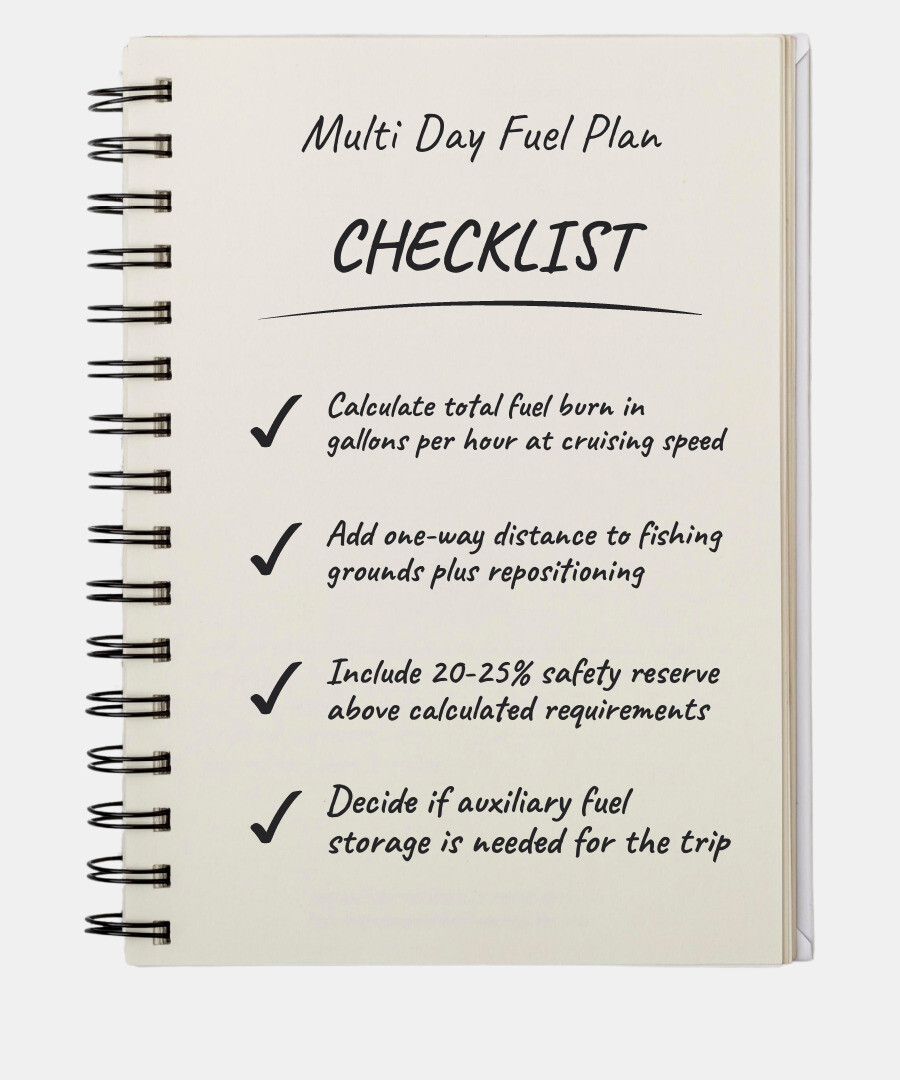
Here’s what every offshore multi day trip fuel plan must cover:
- Total fuel burn — calculate your vessel’s consumption rate at cruising speed (gallons per hour)
- One-way distance — to your target grounds and back, including repositioning between spots
- Safety reserve — always carry a minimum 20–25% reserve above calculated requirements
- Auxiliary capacity — determine whether your fixed tanks are enough, or whether supplemental fuel storage is needed
- Refueling options — identify whether fuel is available at your destination, and at what cost and quality
Unlike a day trip, a multi day offshore run leaves no room for loose estimates. Remote canyons, deep-water grounds, and international fishing destinations often have no fuel infrastructure at all. A shortfall 80 miles offshore is not a minor inconvenience — it is a serious emergency.
That’s where auxiliary fuel storage becomes a practical necessity, not an optional upgrade. Flexible marine fuel bladders let operators carry precisely the extra capacity they need, sized to the space available on deck or below, without permanently modifying the vessel.
This guide walks through every stage of offshore fuel planning for multi day fishing trips — from calculating burn rates and safety margins, to selecting the right auxiliary storage solution and transferring fuel safely at sea.
Relevant articles related to multi day trip:
Logistics and Destination Planning for a Multi Day Trip
Embarking on a multi day trip to target pelagic species in remote ocean canyons requires more than just high-end tackle and a skilled crew. The foundation of any successful long-range voyage is a comprehensive understanding of your route, destination, and the fuel variables that come with them. When heading out to areas where the bottom drops off and the cell service disappears, you are entirely self-reliant.
Selecting your destination is the first step. Whether you are running to the offshore canyons of the Northeast, making the long transit to the Bahamas, or exploring remote fisheries in the Pacific Northwest, your path dictates your fuel strategy. Unlike day trips where you return to a familiar slip each evening, a multi-day journey involves continuous operations: trolling for ten hours a day, keeping generators running overnight to power refrigeration and life-support systems, and battling unpredictable currents.
Understanding the local environment is critical. For instance, if you are planning a trip to a remote destination, you must account for the lack of shoreside support. Having a clear picture of what lies ahead is the difference between a record-breaking catch and a stressful transit. For a deeper look at long-range route preparation, consult Fuel for Thought: The Essentials of Long Range Cruising.
Assessing Fuel Requirements for a Remote Multi Day Trip
A precise fuel calculation is not a simple “distance divided by fuel economy” equation. In the marine environment, fuel burn is a dynamic variable influenced by sea state, wind, vessel payload, and engine RPM.
To accurately assess your fuel requirements for a multi day trip, you must break down your itinerary into distinct phases:
- The Transit Phase: Running at optimal cruising speed to the fishing grounds. This is typically your most fuel-intensive phase per mile.
- The Fishing Phase: Trolling, drifting, or repositioning. While trolling burns less fuel per hour than cruising, doing it for 12 to 14 hours a day over several days adds up to a massive volume.
- The Generator/Auxiliary Phase: If you are staying overnight on the water, your generator will run continuously to power marine electronics, livewells, ice makers, and air conditioning. A generator burning 1 to 2 gallons per hour over a 72-hour trip can easily consume 100+ gallons of your reserve.
- The Contingency Phase: Headwinds, rough seas, or running home on one engine will dramatically increase your fuel consumption.
A standard rule of thumb is the “Rule of Thirds”: one-third of your fuel capacity for the trip out, one-third for the trip back, and one-third held in reserve for unexpected conditions. When planning a remote trip, relying solely on your internal rigid tanks often limits your operational window. To maximize your time on the water without compromising safety, operators frequently look toward auxiliary options to avoid running their tanks critically low. For practical strategies on extending your vessel’s reach safely, see Going the Distance Without Running Your Yacht Dry.
Navigating Regulations and Permits on a Multi Day Trip
Operating a private vessel on an extended voyage often means crossing through marine sanctuaries, state boundaries, or international borders. Each jurisdiction has specific environmental and safety regulations regarding the carriage of fuel.
The United States Coast Guard (USCG) and the Environmental Protection Agency (EPA) enforce strict guidelines regarding auxiliary fuel storage. Standard portable plastic jugs (often referred to as “jerry cans”) are not only highly unstable on a pitching deck, but they also rarely comply with safety standards for transporting large volumes of fuel.
When carrying extra fuel, the storage system must be specifically designed for marine environments. It must resist degradation from UV exposure, saltwater, and the fuel itself (whether diesel or gasoline). Furthermore, if your route takes you through marine protected areas or national parks, any sign of fuel spillage or improper venting can result in severe fines. Utilizing high-quality, closed-loop flexible fuel bladders ensures compliance and protects the pristine marine environments you are traveling to fish.
Optimizing Private Vessel Operations for Multi Day Expeditions
For the serious offshore operator, a multi day trip represents the ultimate test of vessel efficiency. Optimizing your operations means finding the perfect balance between payload weight, speed, and range.
Every gallon of fuel weighs approximately 7.1 pounds (for diesel) or 6.1 pounds (for gasoline). Adding 300 gallons of auxiliary fuel adds over a ton of weight to your deck or cockpit. This added payload changes the vessel’s running angle, draft, and fuel efficiency.
Understanding how to manage this weight is crucial. As the trip progresses and fuel is consumed, the vessel becomes lighter and more efficient. Experienced captains plan their fuel transfer to burn off the auxiliary deck fuel first, returning the vessel to its designed running lines as quickly as possible. This active payload management reduces hull drag and optimizes fuel economy over the course of the expedition. To explore how to combat range limitations and optimize your vessel’s performance under load, check out Range Anxiety: Top Solutions for an Extended Cruising Range.
Analyzing the Economics of Auxiliary Fuel vs. Remote Fueling Stations
When planning a long-range trip, you generally have two choices: carry all the fuel you need with you, or plan to refuel at a remote port or marina along the way. While refueling at a remote outpost sounds convenient on paper, the reality is often economically and logistically challenging.
Consider the following factors when comparing these two strategies:
| Factor | Remote Fueling Station | Carrying Auxiliary Fuel |
|---|---|---|
| Fuel Pricing | Often marked up significantly due to remote logistics (remote surcharges). | Purchased at your home port at standard commercial rates. |
| Fuel Quality | High risk of water contamination, microbial growth, or sediment in low-turnover remote tanks. | Clean, filtered fuel from a trusted local source. |
| Time Efficiency | Requires detouring from the fishing grounds, docking, clearing customs (if international), and waiting in line. | Continuous operation; no down-time or lost fishing hours. |
| Logistical Costs | Can involve overnight dockage fees, port fees, and agent fees. | Zero additional port fees; complete self-reliance. |
By utilizing flexible fuel bladders to carry your own supply, you eliminate the risk of bad fuel ruining your engines mid-trip and bypass the inflated fuel prices common in remote fishing destinations. The return on investment (ROI) of a high-quality fuel bladder is often realized in just a few extended offshore trips.
Auxiliary Fuel Storage Solutions for Extended Range
When your internal tanks are insufficient for your planned itinerary, adding auxiliary storage is the most practical solution. However, installing permanent, rigid aluminum or fiberglass tanks is incredibly expensive, destroys valuable storage space, and permanently alters the vessel’s weight distribution.
Flexible fuel bladders and collapsible fuel tanks offer a superior alternative. Manufactured from high-tensile, fuel-compatible thermoplastic polyurethane (TPU), these bladders lay flat on the deck or in designated compartments when filled. As the fuel is transferred into the main tanks, the bladder collapses, allowing you to fold it up and store it away, completely freeing up your deck space for the ride home.
Choosing the right size and type of bladder is essential for safe operations. Sizing depends on your vessel’s available deck footprint, the type of fuel (diesel or gasoline), and the required range extension. For a comprehensive look at how these systems integrate into your vessel, see The Complete Guide to Marine Auxiliary Storage Bladders and Collapsible Marine Fuel Tanks for Extended Offshore Trips.
Safe Fuel Transfer Procedures Offshore
Transferring fuel on a moving vessel requires strict adherence to safety protocols to prevent spills, static discharge, or engine fuel-system contamination.
The two primary methods for transferring fuel from a deck bladder to your main tanks are:
- Gravity Feed: If the bladder can be positioned higher than the main deck fill (such as on a flybridge or elevated deck step), gravity can be used to slowly drain the fuel. While simple, this method is slow and requires careful routing of the transfer hose.
- Transfer Pumps: Utilizing a dedicated 12V or 24V marine fuel transfer pump is the standard and most efficient method. These pumps can transfer 10 to 20 gallons per minute, emptying a large bladder in a fraction of the time.
Essential Safety Steps for Offshore Fuel Transfer:
- Secure the Bladder: Ensure the bladder is properly tied down using high-strength ratchet straps attached to heavy-duty deck cleats. It must not shift even in rough seas.
- Establish Grounding: Static electricity is a major hazard, particularly when transferring gasoline. Ensure all equipment is properly grounded.
- Use an Inline Filter: Always run the fuel through a water-separating inline filter during the transfer process to catch any condensation or debris.
- Monitor the Transfer: Never leave a running transfer pump unattended. Watch the main tank fuel gauges closely to prevent overfilling and venting fuel into the water.
For a step-by-step technical breakdown of this process, refer to the detailed guide on How to Transfer Fuel from a Fuel Bladder.
Emergency Preparedness and Contingency Planning
At sea, the unexpected should be expected. A sudden shift in wind direction, a clogged fuel injector that forces you to run home on one engine (which significantly decreases fuel efficiency), or a medical emergency requiring a high-speed run to shore can instantly destroy your carefully calculated fuel budget.
A robust emergency plan relies on having a true fuel reserve. This is fuel that is completely isolated from your primary consumption calculations—fuel that exists solely to get you out of a dangerous situation.
If your boat breaks down or is forced to idle for days waiting out a storm, having auxiliary fuel to run your generator and maintain communications, bilge pumps, and basic life-support systems is critical. For a complete guide on how to handle these high-stress situations, see What to Do If Your Boat Breaks Down Out in the Ocean.
To assist operators in planning their emergency reserves, the table below outlines typical flexible fuel bladder capacities and the approximate range extension they offer based on average fuel burn rates:
| Bladder Capacity (Gallons) | Estimated Weight (lbs, Diesel) | Approximate Range Extension (at 15 GPH / 20 Knots) | Ideal Vessel Size |
|---|---|---|---|
| 50 | ~355 | 66 Nautical Miles | 25′ – 32′ Center Consoles |
| 100 | ~710 | 133 Nautical Miles | 30′ – 38′ Sportfish / Express |
| 200 | ~1,420 | 266 Nautical Miles | 35′ – 45′ Flybridge / Catamarans |
| 500 | ~3,550 | 666 Nautical Miles | 45’+ Long Range Cruisers / Yachts |
Note: Range extensions are estimates and will vary based on hull design, sea state, and engine efficiency.
Implementing a dedicated emergency fuel supply system ensures that even if your primary fuel system becomes compromised or contaminated, you have a clean, independent source of fuel to run your propulsion systems. For technical designs of emergency fuel systems, read The Ultimate Guide to Marine Emergency Fuel Supply Systems.
Frequently Asked Questions about Offshore Fuel Planning
How do I calculate my vessel’s safe cruising range?
To calculate your true safe cruising range, you must first establish your actual fuel burn rate at various RPM ranges under a full load. Do not rely on “brochure numbers” which are typically recorded on flat water with minimal fuel and no gear.
- Run your vessel under normal trip loading (full water, gear, and crew).
- Record your fuel burn (Gallons Per Hour) and speed (Knots) at your standard cruising RPM.
- Divide speed by fuel burn to get your Nautical Miles Per Gallon (NMPG).
- Multiply your usable fuel capacity (total capacity minus a 20% safety reserve) by your NMPG to find your safe cruising range.
That head currents and rough seas can reduce your NMPG by 30% or more. For a deeper look into advanced range calculations, see Going the Distance with Extra Fuel Systems.
What are the advantages of flexible fuel bladders over rigid auxiliary tanks?
Flexible fuel bladders offer several distinct advantages over rigid aluminum or plastic auxiliary tanks:
- Space-Saving Design: Once empty, a flexible bladder can be rolled up and stored in a lazarette or console, returning 100% of your deck space to the crew for fishing.
- No Permanent Modifications: They require no cutting, fiberglass work, or permanent plumbing changes to your vessel.
- Custom Sizing: Bladders can be custom-manufactured to fit the exact dimensions of your deck, cockpit, or bow configuration.
- Cost-Effective: They are significantly less expensive to purchase and install than permanent custom metal tanks.
To compare your options and find the best fit for your vessel, read Don’t Get Stranded: Best Marine Fuel Bladder Tank Options for Offshore Trips.
How does weight distribution of extra fuel affect vessel performance?
Adding several hundred gallons of fuel to your deck changes your vessel’s center of gravity. If placed too far aft, it can cause the stern to squat, increasing drag, lowering fuel efficiency, and potentially allowing water to wash over the transom. If placed too far forward, it can cause the bow to plow, making the vessel difficult to steer in a following sea.
Ideally, auxiliary fuel should be positioned as close to the vessel’s center of gravity (LCG) as possible—typically midship or just forward of the cockpit. Always secure the bladder tightly to prevent the fuel from sloshing, which can create unstable handling characteristics in rough seas.
Conclusion
Planning a successful multi day trip offshore requires careful calculation, proper equipment, and a commitment to safety. For serious anglers and commercial operators, range should never be the limiting factor that keeps you from reaching the most productive fishing grounds.
Techno Tanks manufactures premium, heavy-duty flexible fuel bladders and collapsible storage systems designed to withstand the harshest marine environments. Whether you need a standard deck bladder for occasional canyon runs or a custom-engineered fuel storage solution for a long-range expedition, Techno Tanks provides the reliability and capacity extension you need to operate with absolute confidence.
Techno Tanks fuel bladder pricing depends on size, fuel type, configuration, application, custom requirements, and project scope. To find the perfect fuel solution for your vessel and receive an accurate pricing quote tailored to your specific requirements, contact our team of marine fuel experts today.
Explore Techno Tanks Marine Fuel Bladders or Contact Us to request a custom quote for your vessel.

