
What Are Fuel Transfer Systems and How Do You Choose the Right One?
Fuel transfer systems are the combination of pumps, hoses, fittings, nozzles, and storage vessels that move fuel safely from one point to another — whether that’s from a shore tank to a vessel, from a truck bed to heavy machinery, or from an auxiliary bladder to a main tank at sea.
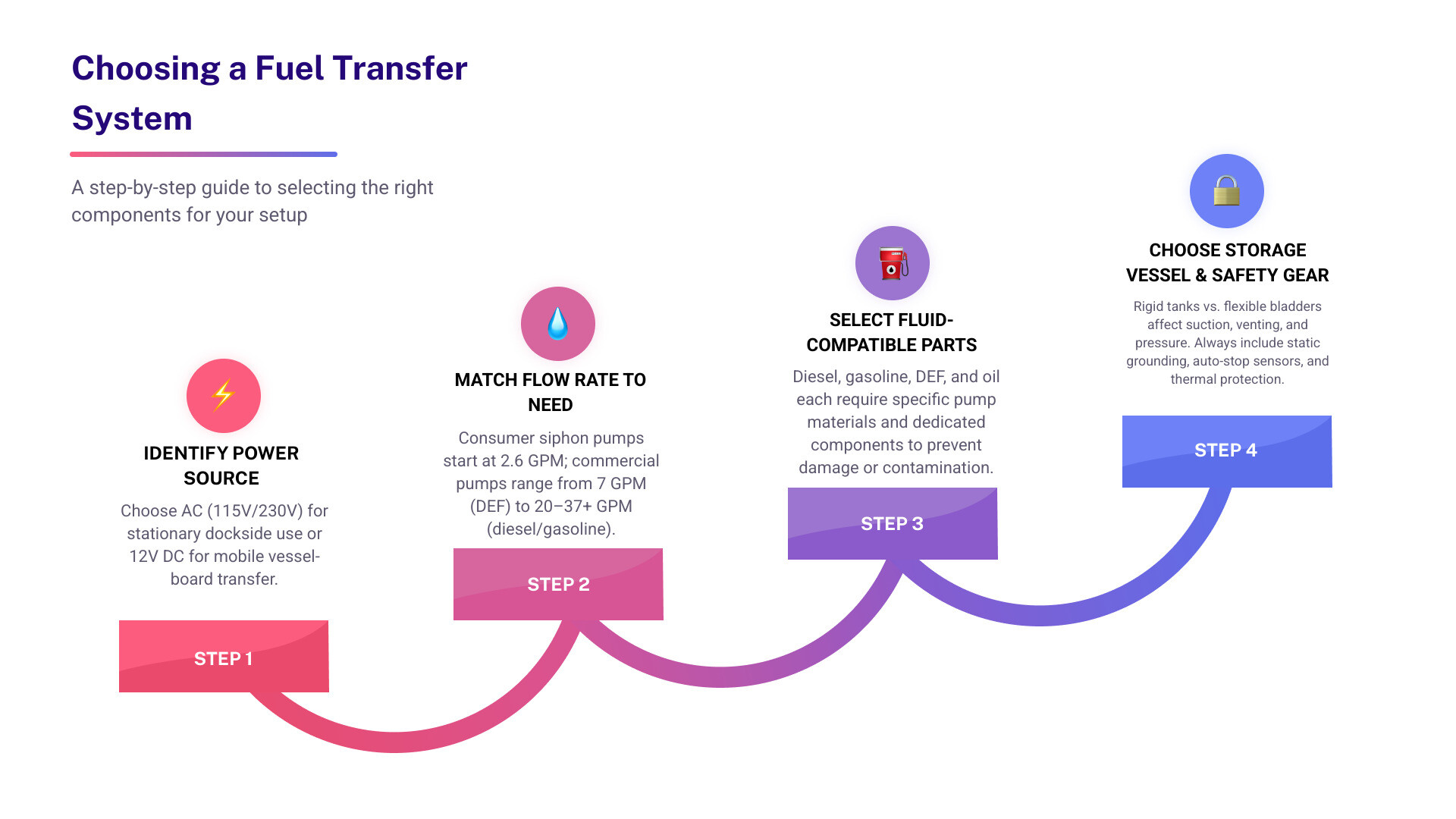
If you need a quick answer, here’s what choosing the right system comes down to:
- Power source — AC (115V/230V) for stationary or dockside use; 12V DC for mobile or vessel-board use
- Flow rate — consumer siphon pumps start around 2.6 GPM; commercial pumps range from 7 GPM (DEF) up to 20–37+ GPM (diesel/gasoline)
- Fluid type — diesel, gasoline, DEF, and oil each require compatible pump materials and dedicated components
- Storage vessel — rigid tanks vs. flexible bladders affect how you manage suction, venting, and pressure during transfer
- Safety requirements — static grounding, auto-stop sensors, thermal protection, and regulatory compliance vary by fuel type and application
For operators extending range, adding auxiliary capacity, or deploying fuel in remote or offshore environments, the storage vessel itself is just as critical as the pump. Flexible fuel bladders — collapsible, custom-sized, and space-efficient — are increasingly used alongside mechanical transfer equipment as a practical alternative to permanent rigid tanks.
This guide covers every layer of a complete fuel transfer system: pumps, fittings, fluid compatibility, safety, and how flexible bladder-based systems integrate with each component.
When a bladder-based transfer system needs a detachable fuel line, the connector becomes part of the system design—not an afterthought. For Techno Tanks setups, compare your requirements with the Fuel Line Quick Connector and verify the hose, thread/interface, fuel, and engine-side requirements before selecting hardware.
Key Components of Bladder-Based Fuel Transfer Systems
A reliable fuel transfer system is only as strong as its weakest connection. When using a flexible bladder instead of a rigid metal or plastic tank, the choice of components must account for the unique physical dynamics of a collapsible vessel.
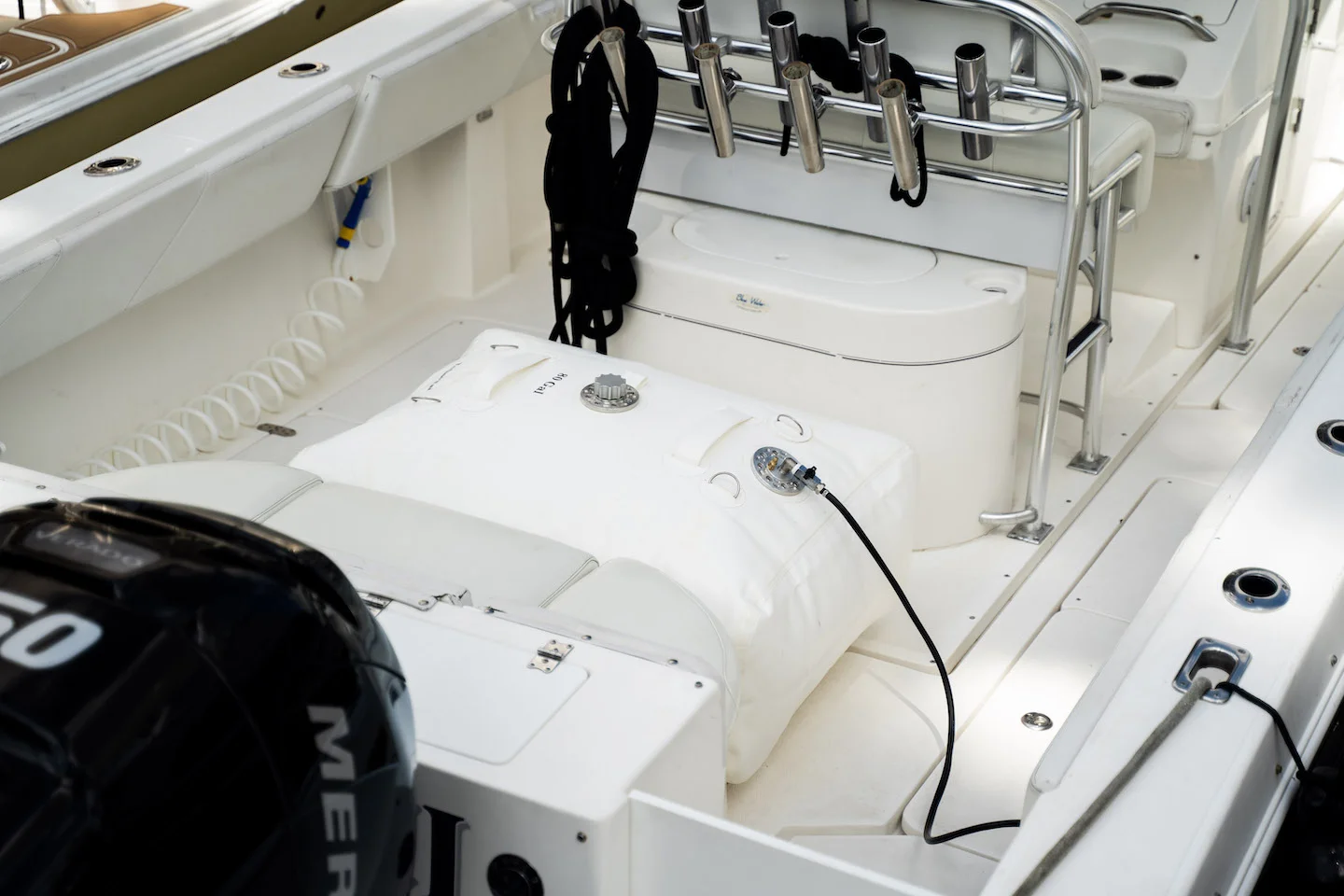
To build a secure, leak-free setup, operators must coordinate several key components:
- The Transfer Pump: The mechanical heart of the system. It must provide enough suction lift to draw fuel without causing excessive negative pressure that could pinch or collapse the bladder’s internal flow path.
- The Flow Meter: Essential for tracking usage, managing fuel inventory, and preventing overfills. Digital or mechanical meters must be calibrated to the viscosity of the specific fuel being moved.
- Dispensing Hoses: Standard hoses will not suffice. Systems require heavy-duty, UV-resistant, and fuel-compatible hoses with integrated static ground wires to prevent static spark hazards during high-velocity fuel flow.
- Automatic Nozzles: Equipped with auto-stop sensors, these shut off the flow when the receiving tank is full, preventing environmental contamination.
- Fittings and Couplings: These secure the connection between the flexible bladder and the rigid transfer lines. Understanding the threading, pressure ratings, and seals is critical, as detailed in this guide on everything you need to know about boat fuel tank fittings.
Integrating Fuel Transfer Systems with Flexible Bladders
Deploying fuel transfer bladders requires a shift in how operators think about fuel movement. Unlike rigid steel or aluminum tanks, which maintain a fixed volume and require continuous atmospheric venting to prevent vacuum lock, flexible bladders collapse as fuel is drawn.
This collapsible nature offers a massive advantage: because there is no air headspace inside the bladder, there is no vapor buildup or condensation risk. However, it also changes the transfer dynamics. Operators can choose between two main methods when learning how to transfer fuel from a fuel bladder:
- Gravity Feed: The bladder is positioned higher than the receiving tank. Gravity naturally pulls the fluid down, collapsing the bladder smoothly. While simple and requiring no electrical power, gravity systems are slow and unsuitable for high-volume or rapid-refueling applications.
- Pumped Transfer: A dedicated auxiliary pump actively draws fuel from the bladder. This is the preferred method for commercial fleets, offshore vessels, and heavy machinery. When using a pump, the flow rate must be carefully matched to the bladder’s outlet diameter to prevent cavitation or localized suction pinches.
Using flexible bladders as an auxiliary storage solution provides vessels and vehicles with the range extension they need without the permanent weight penalty of rigid tanks. To understand how these systems function in marine environments, operators can consult the complete guide to marine auxiliary storage bladders and explore the operational benefits of going the distance with extra fuel systems.
Essential Fittings and Quick Disconnects
In any bladder-based system, the connection points are the most vulnerable to leaks and physical strain. Because flexible bladders move, shift, and contract as fuel levels change, rigid threaded pipe connections can stress the bladder material and lead to premature wear or threading failure.
To solve this, commercial systems utilize specialized quick disconnects and camlock couplings. These components allow operators to connect and disconnect transfer lines rapidly without tools, dry-disconnecting to ensure not a single drop of fuel is spilled.
Selecting high-quality fittings prevents environmental contamination and system downtime. For step-by-step guidance on selecting and mounting these components, operators should refer to the instructions on no tools no leaks how to choose and install quick disconnect fuel line fittings. Additionally, checking the essential guide to fuel line quick connect adapters ensures compatibility across different hose sizes, while marine-specific requirements are detailed in the guides on no more leaks with the best marine fuel tank quick disconnects and the best way to connect your outboard fuel line fast.
Selecting the Right Pump for Flexible Bladder Transfer
Selecting a pump for a flexible system requires matching the pump’s performance specs to the physical limits of the bladder. The key parameters to look for include:
- Flow Rate (GPM): The volume of liquid moved per minute. While higher GPM speeds up operations, too high of a flow rate can collapse the bladder’s discharge port before the rest of the fluid can shift toward the outlet.
- Duty Cycle: The maximum continuous run time before the pump motor must shut down to cool. A standard commercial duty cycle is 30 minutes on and 30 minutes off.
- Suction Lift: The vertical distance a pump can pull fluid up from a lower level. For flexible bladders, minimizing suction lift by placing the pump level with or below the bladder maximizes transfer efficiency.
- Discharge Head: The vertical lift on the outlet side of the pump.
The table below compares the primary pump types used for bladder integration:
| Pump Type | Typical Flow Rate | Common Power Sources | Best Applications | Key Limitations |
|---|---|---|---|---|
| AC Electric | 20 to 35+ GPM | 115V AC / 230V AC | Stationary fuel depots, commercial docks, boat yards | Requires grid power or large generator |
| DC Electric | 15 to 20 GPM | 12V DC / 24V DC | Mobile truck beds, vessel-board transfer, remote fields | Limited by battery life, 30-min duty cycle |
| Manual / Rotary | 5 to 8 GPM | Hand crank / Siphon | Emergency backup, small volume transfers, light duty | High physical effort, slow transfer speeds |
AC vs. DC Powered Auxiliary Pumps
The choice between AC and DC power is determined by where the transfer takes place.
For stationary, high-volume operations, AC-powered pumps are the industry standard. For example, a heavy-duty 115V AC pump like the FR701VL – 115V AC 20 GPM Fuel Transfer Pump | Fill-Rite delivers a robust 20 GPM flow rate, making it perfect for rapid dockside transfers or stationary fuel yards. For international operations or industrial sites with higher voltage availability, the FR701VG – 230V AC 20 GPM Fuel Transfer Pump | Fill-Rite provides the same 20 GPM output with a lower current draw (2.4 A max), reducing the load on commercial electrical systems.
For mobile, off-grid, or vessel-board applications, DC-powered pumps are highly practical. Operating on 12V or 24V power, these pumps connect directly to vehicle or boat batteries. A pump like the FR1210HTKD – 12V DC 15 GPM Fuel Transfer Pump | Fill-Rite delivers 15 GPM, which balancing speed and battery draw perfectly for remote refuels.
Manual rotary systems, such as the FLO-FAST Pro Fluid Transfer System | Fluidall, require no electrical power at all. Capable of pumping or siphoning up to 8 GPM, these systems are excellent options for light-duty utility tasks or emergency backup.
To find the right balance for your vessel, refer to this detailed guide on the best marine grade auxiliary pumps for reliable fuel transfer and review options for keep your boat buzzing with these foldable marine fuel transfer tanks.
Flow Rate and Vacuum Considerations for Flexible Systems
When pumping from a flexible bladder, the pump’s suction creates a pressure differential that draws the fluid out. Because the bladder is collapsible, it naturally shrinks to fit the remaining fuel volume. However, if a high-flow pump is paired with a bladder that has a restrictive outlet, the pump can create an excessive internal vacuum. This can pinch the bladder walls together, blocking the fuel flow and causing the pump to run dry, which can damage rotary vanes and seals.
To prevent this:
- Match high-flow 230V AC pumps (20+ GPM) or high-flow 12V DC pumps like the FR4210H – 12V DC 20 GPM Fuel Transfer Pump | Fill-Rite with larger bladder discharge ports (typically 1.5 to 2 inches).
- Avoid running the pump at full speed when the bladder is nearly empty.
- Ensure the bladder construction features high-tensile TPU materials that resist twisting and pinching under suction.
For more information on selecting and operating collapsible storage safely, see collapsible fuel tanks an essential guide and smooth sailing the ultimate guide to collapsible marine fuel systems.
Fluid Compatibility and Bladder Material Selection
Using the wrong pump or bladder material for a specific fluid is a recipe for system failure, leaks, or fire. Different fluids exhibit varying chemical properties, viscosities, and flammability levels, requiring targeted material selections.
Thermoplastic Polyurethane (TPU) is the material of choice for high-performance flexible bladders. However, the specific formulation of the TPU must match the chemical makeup of the fuel. For example, gasoline contains aromatic hydrocarbons that degrade standard industrial polymers, requiring specialized, gas-compatible barrier layers.
To ensure safety and longevity, operators must consult the ultimate compatibility guide choosing the right fuel bladder for gasoline, explore gas compatible gasoline tanks that actually last, and understand why gas safe flexible bladders are changing fuel storage forever.
Diesel and Gasoline Transfer Requirements
The physical differences between diesel and gasoline dictate distinct handling protocols:
- Diesel Fuel: Highly stable with a high flashpoint. It is less prone to ignition from static electricity but is highly susceptible to water contamination and microbial growth. Diesel-specific systems prioritize heavy filtration (such as 10-micron water-separating filters) and robust, high-volume transfer rates. For diesel storage, operators rely on dedicated diesel fuel bladders.
- Gasoline: Extremely volatile with a low flashpoint. Gasoline vapors can ignite from a single static spark. Consequently, gasoline transfer systems must utilize UL-listed, explosion-proof motors, static-grounding wires on all hoses, and vapor-tight connections.
For gasoline systems, choosing a compatible bladder is critical. Operators should review options like gasoline fuel bladders, and learn more about safety configurations via no leaks allowed with these gas compatible marine tanks, how to choose gas compatible boat bladders without sinking your budget, and why you need gas compatible petrol bladders for off roading.
Operational Safety, Regulations, and Best Practices
Operating fuel transfer systems requires strict adherence to environmental and safety regulations. The EPA (Environmental Protection Agency) and DOT (Department of Transportation) enforce rules governing fuel transport, spill prevention, and emissions control.
When deploying mobile or offshore auxiliary fuel systems, compliance is achieved by choosing equipment with the right built-in safety features:
- Thermal Overload Protection: Automatically shuts down the pump motor if it overheats, preventing ignition hazards in vapor-rich environments.
- Static Grounding Wires: Essential for grounding the pump, hose, and receiving vessel to discharge static electricity safely.
- Auto-Stop Sensors: Nozzles equipped with automatic shut-off sensors prevent overfilling and fuel spills.
For offshore and commercial operations, choosing compliant equipment is paramount. Operators can read about regulatory standards and system designs in offshore fuel solutions.
Preventing Contamination and Spills
Fuel contamination, particularly from water and airborne particulates, can destroy high-pressure common-rail fuel injection systems. To maintain fuel purity, a complete transfer system must include:
- Inlet Mesh Strainers: Typically integrated into the pump inlet (such as a 20×20 micron mesh) to catch large debris.
- Hydrosorb Filters: Downstream 10-micron filters that actively absorb water and trap fine particulates before they reach the engine.
- Secondary Containment: When using flexible bladders in sensitive environments, placing the bladder within a secondary containment berm or utility space ensures that any accidental fitting leak is safely contained.
For offshore voyages where fuel purity is a matter of survival, selection guides such as how to choose the safest offshore fuel bladder systems for your next voyage are invaluable.
Venting and Pressure Management in Flexible Systems
While rigid tanks require constant venting to prevent vacuum lock or overpressure, flexible TPU bladders naturally expand and contract. However, pressure management is still necessary. During high-velocity filling, air pockets can become trapped inside the bladder.
To manage this safely:
- Use integrated pressure-relief and air-vent valves to vent trapped air during the initial stages of filling.
- Ensure the bladder material is rated for the dynamic pressure of the incoming fuel flow.
- Monitor the bladder during transfer to ensure even expansion.
For emergency and backup systems, understanding these principles is key. Operators can consult the ultimate guide to marine emergency fuel supply systems, dont run dry emergency marine fuel storage tips for boaters, dont get stranded best backup fuel bladders and containers for your vehicle, dont get stranded with these top portable boat fuel tanks, and dont get stranded best marine fuel bladder tank options for offshore trips.
Frequently Asked Questions about Fuel Transfer Systems
What is the difference between AC and DC fuel transfer pumps for auxiliary bladders?
AC pumps (115V or 230V) are designed for stationary applications connected to grid power or heavy generators, offering continuous run times and high flow rates (20 to 35+ GPM). DC pumps (12V or 24V) run off vehicle or vessel batteries, making them highly portable and ideal for remote, mobile, or vessel-board fuel transfers, though they typically operate on a 30-minute duty cycle.
How do you prevent static buildup during gasoline transfer from a flexible bladder?
To prevent static buildup, the transfer pump must be explosion-proof and UL-listed. Additionally, the discharge hose must contain an integrated static ground wire, and a bonding cable must connect the pump housing directly to the receiving vehicle or vessel’s frame before transfer begins.
How do flexible fuel bladders compare to rigid tanks for auxiliary storage?
Flexible bladders offer a space-saving, collapsible design that shrinks as fuel is discharged, eliminating vapor headspace, condensation, and the need for complex atmospheric venting. They are lighter, custom-sized, and can be rolled up and stored away when not in use. Rigid tanks are highly durable but take up permanent space, add constant weight, and require dedicated venting systems. For a detailed comparison, see fuel bladder vs fuel tank, flexible tanks vs rigid tanks why custom bladders win every time, and collapsible fuel tanks.
Conclusion
Choosing the right fuel transfer system requires careful consideration of pump power, flow rates, fluid compatibility, and storage design. For serious operators, commercial fleets, and offshore vessels, integrating high-quality pumps with flexible TPU fuel bladders provides a safe, highly efficient, and space-saving solution for range extension and temporary fuel storage.
Techno Tanks manufactures premium flexible fuel bladders and collapsible storage systems designed to withstand the most demanding marine and commercial environments. Built with high-tensile, fuel-compatible TPU materials, these bladders are available in custom sizes ranging from 30 to 3,000 gallons.
Because every commercial application, marine vessel, and logistics project has unique sizing, fuel compatibility, and space requirements, Techno Tanks pricing is fully customized. To find the exact solution for your needs, explore the fuel bladder sizing guide, review the fuel bladder pricing information, and request a personalized quote based on your project scope by visiting the contact us page today.

